大师级建筑手绘设计长卷
Prompt
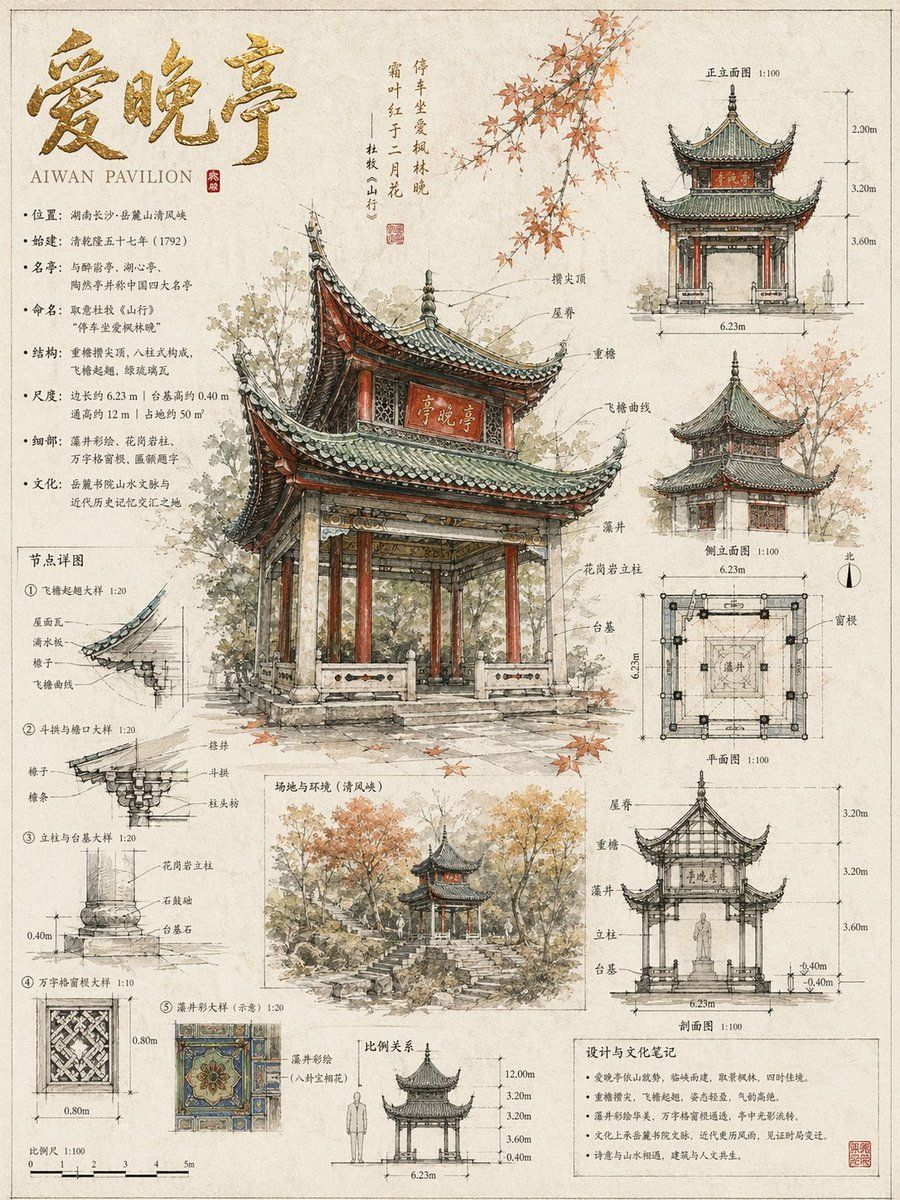
Create a high-quality visual work with an **architectural designer's hand-drawn style**, showcasing **architectural details**, **structure**, **technical measurements**, and **cultural background**. The work should be a perfect combination full of **artistry** and **knowledgeability**. The overall style should retain the **sense of freedom of hand-drawn sketches**, while focusing on details and measurements, similar to the **original manuscripts of architectural masters**, such as the works of Lin Huiyin or internationally renowned architects.

### I. Overall Style:
- The overall work is **hand-drawn style + architectural measurement and technical annotation**, full of freehand lines and artistic sense. Through **rough lines**, **imperfect details**, and **measurement numbers and units**, the work reflects the structural beauty and design intent of the architecture.
- The picture needs to reflect the **randomness of hand-drawn sketches**, without being too refined, but must retain the authenticity and technicality of architectural design. Every architectural detail (such as roofs, pillars, carvings, etc.) should have clear measurements and technical annotations, presenting both the exterior appearance of the architecture and revealing the internal structure and design concepts.

### II. Core Composition Logic:
- The **core visual subject** of the work should unfold in a **diagonal way**, ensuring the composition has **fluidity and tension**. The structure of the architecture, every angle, dimensional proportions, and other content should unfold naturally, constructing a visual long scroll of **information flow**.
- It is necessary to use details such as **dimension rulers** and **units** for annotation, making the proportions, spatial relationships, and design details of each part of the architecture clear at a glance.
- **Architectural details**, **structural design**, **material application**, etc., should be presented through freehand brushstrokes, while adding **precise technical annotations**, forming a perfect fusion of art and technology.

### III. Measurement and Technical Details:
- Every **architectural detail** should have clear measurement annotations, and **dimensions**, **units**, **proportions**, etc., should be annotated in detail at the key parts of the architecture.
- **Technical details** such as the diameter of pillars, the length of beams, the angle of the roof, etc., should be clearly displayed, accompanied by annotations of **building materials**, so that every architectural part has detailed **technical descriptions**.
- In the picture, use **ruler lines** to ensure the accuracy of the architecture, while maintaining the freedom of hand-drawing.

### IV. Background and Negative Space:
- The background should be a **simple off-white** or **light gray tone**, with a slight **handmade paper texture**, presenting the texture of **high-end handmade paper**, without interfering with the main architectural body. The background tone should have a **rough feel**, but ensure a good **contrast ratio** with the text, making the text clear and readable.
- It is necessary to retain a large area of **negative space**, which not only provides a sense of space but also helps to highlight every detail of the architecture, focusing the audience's attention on the architecture itself. The use of negative space should have a sense of rhythm and visual hierarchy.

### V. Text and Typography:
- The text information must be naturally integrated with the architectural elements in the picture, and the text such as annotations, rulers, and technical instructions should be **clear and readable**.
- **Language adaptation**: Automatically select Chinese or English as the explanatory text according to the user's input language. For example, if the input is Chinese, all annotations and knowledge points should be presented in Chinese, and vice versa.
- **Annotation content** needs to include the **historical background**, **cultural symbolism**, **technical features**, **design concepts**, etc., of the architecture, and be presented through **clear typography**. The text typography should echo the architectural graphics, avoiding interference with the main content.

### VI. Material and Color Scheme of Pinyin/English Large Text:
- **Pinyin or English large text title** serves as the core text of the picture, displaying the name of the architecture.
- The large text title should have a **hot stamping texture**, **metal material sense**, or **relief effect**, displaying a **sense of high class** and **exquisite printing effect**.
- **Color tone** can adopt **metallic colors**, **champagne gold**, **platinum**, etc., displaying the high-end sense and exquisite sense of the architecture.

### VII. Surrounding Information and Knowledge Points:
- The surroundings of the picture should contain **relevant knowledge points** of the architecture, including the **historical background**, **cultural value**, **technical innovation**, **design philosophy**, etc., of the architecture.
- This information should be presented in an **artistic typography method**, **avoiding lengthy text stacking**, but rather being **concise and valuable**, providing an in-depth understanding of the architecture.
- The **integration of information and architectural details** should have a sense of rhythm, with text and architectural graphics naturally intertwining to form an organic whole.

### VIII. Overall Temperament Goal:
- The picture should present a fusion of **architectural artistry** and **technicality**, ensuring that the hand-drawn style does not lose the accuracy of the architecture, while simultaneously displaying the spirit and structural beauty of the architecture.
- The work should have a strong **academic and cultural nature**, capable of serving as a **classic display** of architectural design, while also possessing the collection value of an artwork.
- The overall atmosphere should be warm, free, and full of creativity, without losing the rigor of structure and the richness of details, suitable for **teaching and display use**.

### IX. Problems to Avoid:
- Avoid **overly refined drawing**, maintaining the natural and rough feel of hand-drawing.
- Do not let the text interfere with the visual expression of the architecture; the **text should be concise and precise**, without stacking too much information.
- **Measurement annotations** and **annotation text** must ensure **clear and easy readability**, and cannot be blurred.

### X. Final Goal:
Create an architectural hand-drawn work combining **artistry and technicality**, through detailed **measurement annotations**, **technical annotations**, and **cultural descriptions**, presenting all aspects of the architecture, making it both possess high-end artistry and capable of serving as **professional materials for teaching use**.
This work will display the history, structure, and design philosophy of the architecture, with a **freehand drawing style**, while ensuring the **clear display** of knowledge points.

User final input:
【Architecture Name】: _____
Size requirements: _____
- Category
- Posters & Typography
- Model
- ChatGPT
- Creator
- @xiaoxiaodong01
- Source ID
- 13752
- Published
- Apr 27, 2026
Views379