鞋中微缩百年社会
Prompt
instruction>

Input A is a Historical Era (e.g., 1700s, 1920s, 1990s, Cyberpunk).
Break the Era into   4 Socio-Economic Archetypes   to ensure variety:
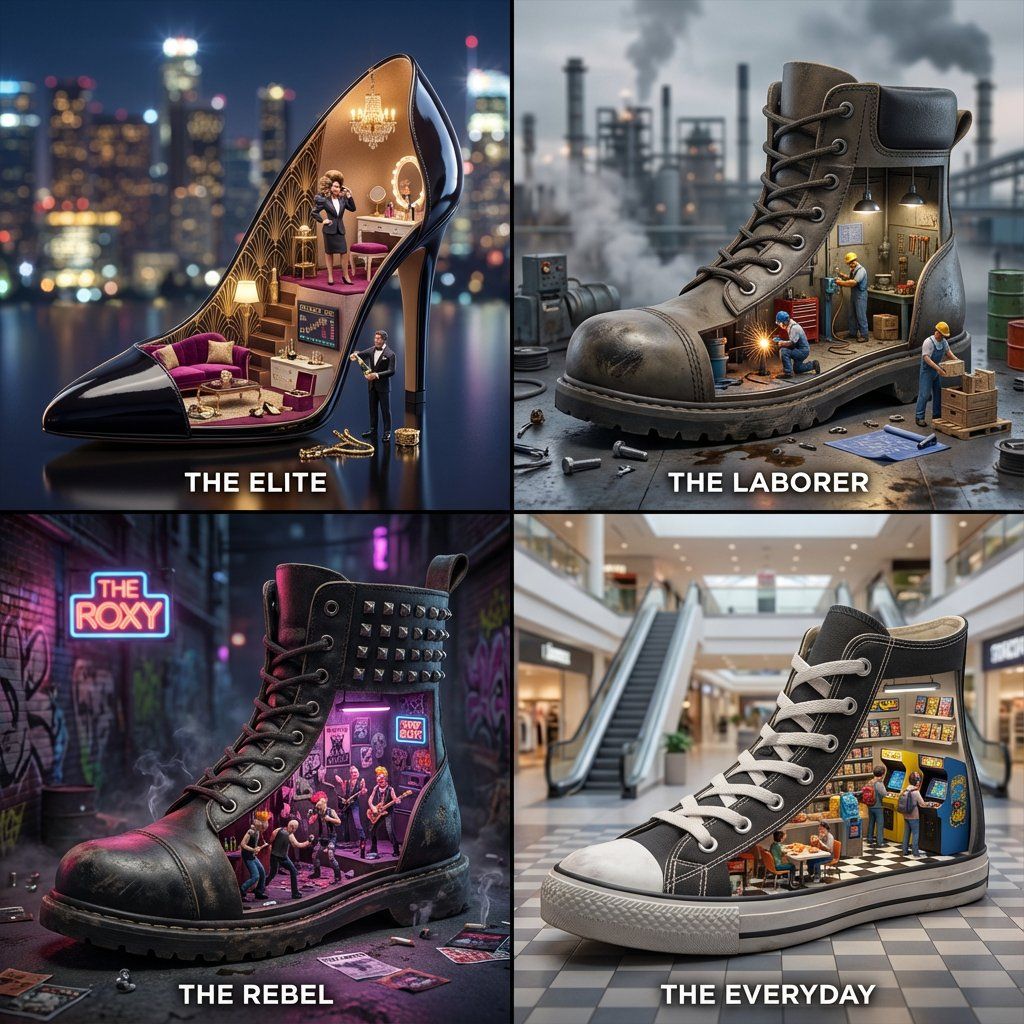
     The Elite (High Class):  Wealth, luxury, vanity.
     The Laborer (Working Class):  Industry, grit, exhaustion.
     The Rebel (Counter-Culture):  Music, underground, nightlife.
     The Everyday (Domestic):  School, home, groceries.

  2.  Container (The Shoe Estate):
     Format:  2x2 Grid.
     The Object:  A distinct Shoe Silhouette for each Archetype (e.g., Silk Heel, Work Boot, Creeper, Loafer).
     The Cutaway:  The side of the shoe is removed to reveal a   Multi-Level Interior  .

  3.  Micro-Population
  CRITICAL:   The shoe is inhabited by   1:12 Scale Figures  .
     The Resident:  Identify who lives/works in this shoe.
         (e.g., 1920s Heel -> A Flapper applying makeup. 1950s Boot -> A Mechanic wiping grease. 1700s Buckle Shoe -> A Merchant counting coins).
     The Interaction:  The figures are   Active  , not static. They are climbing ladders, stocking shelves, serving drinks, or lounging on the furniture.

  4.  Interior Design
     The Architecture:  Custom flooring, wallpaper, and lighting fixtures match the shoe's vibe.
     The Density:  Do not just place items on shelves.   Scatter them.
         Elite:  Open jewelry boxes, spilled powder, silk ribbons.
         Laborer:  Oil stains, scattered nails, blueprints, sawdust.
         Rebel:  Vinyl records on the floor, cigarette smoke, posters.
         Everyday:  Groceries, books, folded laundry.

  5.  Contextual Background
    The Background is   Blurred (Bokeh)   but implies the location where the shoe is worn.
         Elite:  Ballroom chandeliers / Opera box.
         Laborer:  Factory steam / Farm fields.
         Rebel:  Dark Alley / Jazz Club neon.
         Everyday:  Suburban street / Market stalls.

  6. Lighting & Atmosphere:
     Diegetic Lighting:  The light comes from miniature sources  inside  the shoe (e.g., a tiny chandelier, a hanging shop bulb, a neon bar sign).
     Scale:  Macro photography depth of field. The figures must look like high-quality hand-painted miniatures.

  Output:   ONE image containing a 2x2 Grid, 1:1 Aspect Ratio, 3D Diorama Render, "Miniature Life" aesthetic, 8k.
</instruction>- Category
- Posters & Typography
- Model
- Nano Banana Pro
- Creator
- @Gdgtify
- Source ID
- 2205
- Published
- Jan 25, 2026
Views108