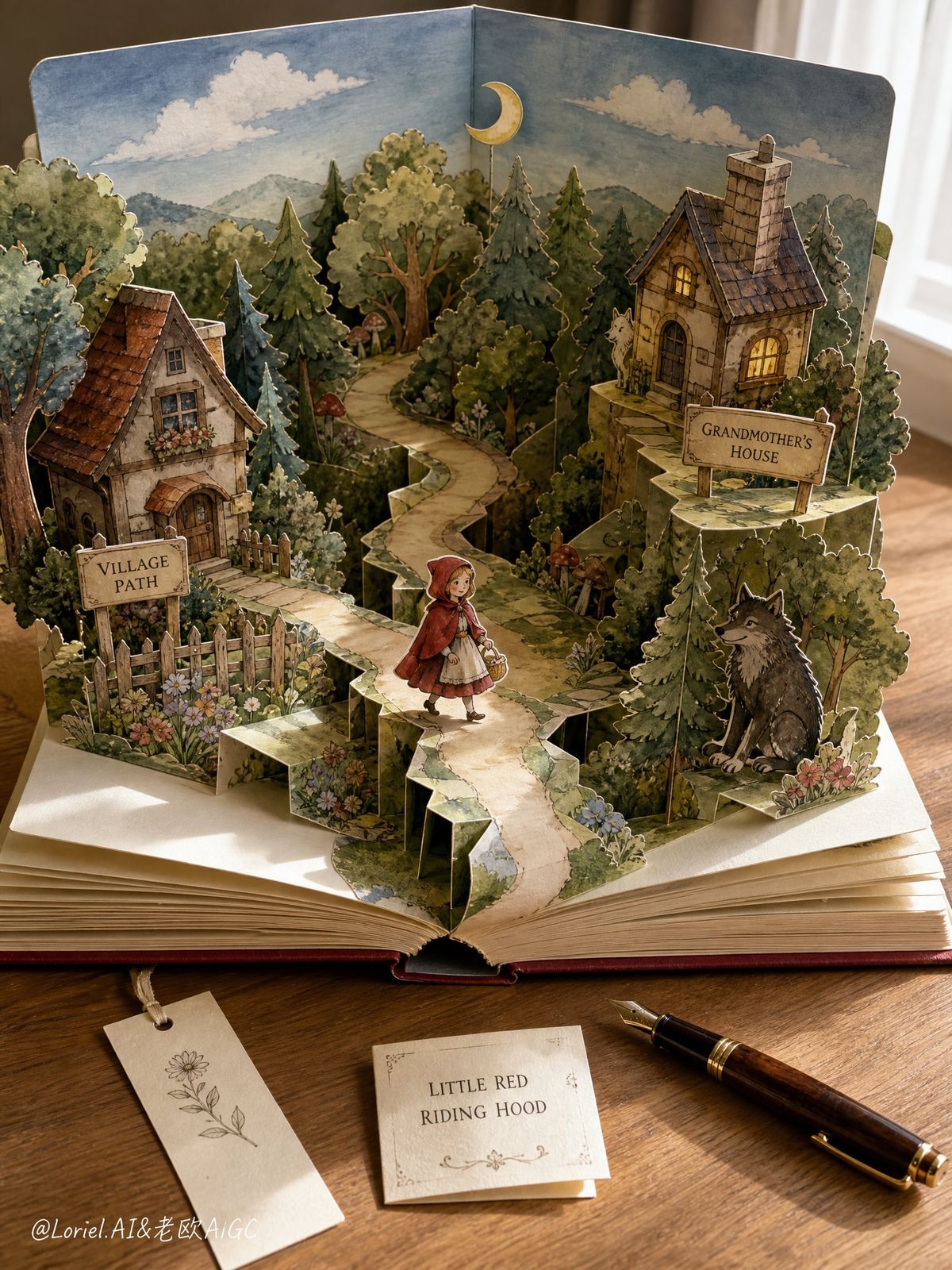
手工立体童话故事书模型
Prompt
Photorealistic vertical product-style still life of a dramatically engineered handmade pop-up storybook on a clean {argument name="surface" default="wooden tabletop"}, viewed from a {argument name="camera angle" default="slightly overhead"} camera angle, clearly showing the 3D paper construction. The book is open wide at about 110 degrees, thick cream pages spread outward, with tall folded paper walls, accordion supports, V-fold mechanisms, stepped platforms, pull-tab layers, visible fold lines, support tabs, die-cut edges, and layered paper silhouettes casting real shadows across the pages.\n\nMain pop-up scene: a familiar {argument name="theme" default="Little Red Riding Hood fairytale world"} built as a deep multi-layer paper theater. Center foreground: a small adult-storybook-style girl character in a bright red hooded cloak walking on a raised winding paper path, holding a tiny basket, standing as a separate vertical cutout layer. Left side: a cozy village cottage with flower boxes, a wooden fence, and a sign reading “VILLAGE PATH”. Center background: a dense enchanted forest made of many upright tree cutouts in staggered depth planes, overlapping green canopies, mushrooms, wildflowers, and shadowed bushes. Right side: grandmother’s cottage standing on a raised paper platform, warm yellow window glow, stone chimney, and a sign reading “GRANDMOTHER’S HOUSE”. Lower right: a friendly storybook wolf silhouette partly hidden behind layered trees, non-threatening fairytale style. Rear background: pale blue sky, soft clouds, distant hills, and a small moon cutout rising from the book spine.\n\nStrong 3D pop-up emphasis: obvious paper hinges, slot joints, folded tabs, curled page edges, layered gap shadows, cardstock thickness, hand-cut edges, watercolor paper fibers, tiny glue marks, miniature stage depth from front to back. Clean desk environment: uncluttered warm wooden tabletop, one fountain pen placed neatly to the side, one small cream bookmark, one simple folded note card labeled “LITTLE RED RIDING HOOD”, no scattered clutter, no game cartridges, no messy papers. Soft natural window light from the right, gentle shadows, crisp central book scene, shallow depth of field, handcrafted watercolor-and-ink illustration style inside the book, realistic macro photography, nostalgic fairytale diorama, 9:16 vertical composition.- Category
- Products & E-commerce
- Model
- GPT Image 2
- Creator
- Loriel.AI
- Source ID
- 27752
- Published
- Jul 6, 2026
Views0



![A 3D pop-up book illustration featuring a [subject], with layered paper elements](https://i.pixshop.app/storage/v1/render/image/public/prompt-source-media/promptsref/work-10840/image-1-7af31ad75cc44ec0.png?width=800&quality=75&resize=contain)