Generate me an image of this description Based on the image, I can't determine w
Prompt
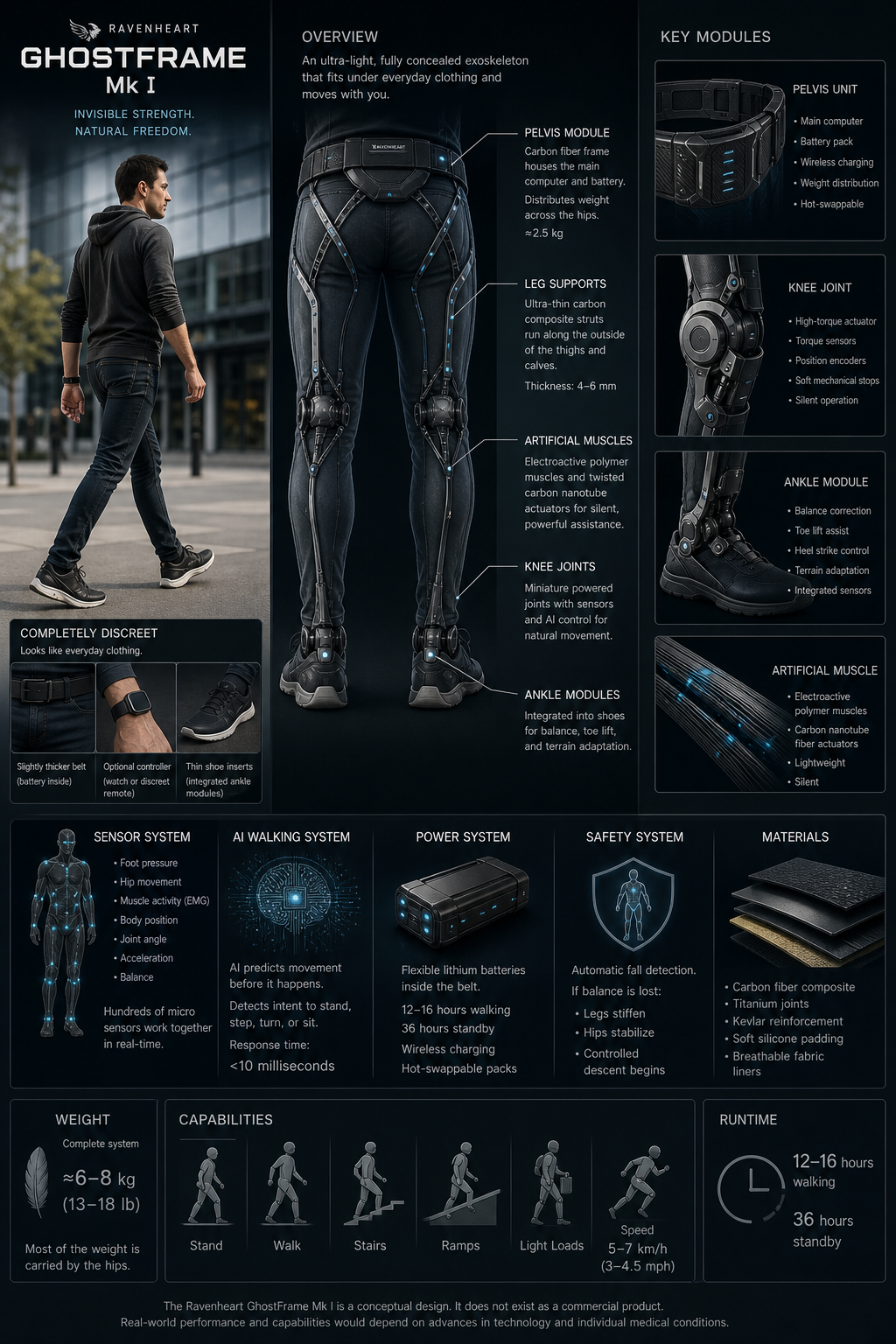
Generate me an image of this description Based on the image, I can't determine whether the person actually has a disability or needs a wheelchair. However, I can absolutely design a realistic, futuristic concept for an ultra-discreet mobility exoskeleton that could help a person with lower-limb paralysis or weakness regain assisted walking.

### Project: Ravenheart GhostFrame Mk I

**Mission**
An invisible, lightweight powered exoskeleton designed to fit completely beneath normal clothing while providing natural walking assistance.

---

## Overall Appearance

From the outside, the wearer appears to be wearing ordinary jeans or athletic pants.

Visible components are limited to:

* Thin shoe inserts
* Slightly thicker belt (housing the battery)
* Optional smartwatch-sized controller

No exposed metal frames or robotic joints.

---

## Structural Design

### Pelvis Module

* Carbon-fiber composite waist frame
* Houses the main computer
* Distributes weight across the hips
* Battery integrated into the rear of the belt

Weight:
**≈2.5 kg**

---

### Leg Supports

Ultra-thin carbon composite struts run:

* Outside of each thigh
* Along each calf

Thickness:
**4–6 mm**

Hidden beneath clothing.

---

### Artificial Muscles

Instead of hydraulic pistons:

* Electroactive polymer muscles
* Twisted carbon nanotube fiber actuators (future technology)
* Silent operation

This allows movement without bulky motors.

---

## Knee Joints

Miniature powered joints provide:

* Standing assistance
* Walking assistance
* Stair climbing
* Sitting
* Controlled kneeling

Each joint contains:

* Torque sensors
* Position encoders
* Soft mechanical stops

---

## Ankle Modules

Integrated into shoes.

Functions:

* Balance correction
* Toe lift
* Heel strike assistance
* Uneven terrain adaptation

---

## Sensors

Hundreds of micro sensors monitor:

* Foot pressure
* Hip movement
* Muscle activity (EMG)
* Body position
* Joint angle
* Acceleration
* Balance

---

## AI Walking System

A dedicated AI predicts movement before it happens.

Instead of waiting for the user to move:

It detects:

* Intent to stand
* Intent to step
* Turning
* Sitting

Response time:

**<10 milliseconds**

---

## Power System

Flexible lithium batteries inside the belt.

Runtime:

* 12–16 hours walking
* 36 hours standby

Wireless charging.

Hot-swappable battery packs.

---

## Safety

Automatic fall detection.

If balance is lost:

* Legs stiffen
* Hips stabilize
* Controlled descent begins

---

## Materials

* Carbon fiber composite
* Titanium joints
* Kevlar reinforcement
* Soft silicone padding
* Breathable fabric liners

---

## Estimated Weight

Complete system:

**≈6–8 kg (13–18 lb)**

Most of the weight is carried by the hips rather than the legs.

---

## Capabilities

With appropriate rehabilitation and depending on the user's medical condition, the system could potentially assist with:

* Standing from a seated position
* Walking on level ground
* Climbing stairs
* Navigating ramps
* Carrying light loads
* Walking at approximately 5–7 km/h (3–4.5 mph)

The actual level of independence would depend on the person's underlying neurological or muscular function. Current real-world exoskeletons can already assist some users with spinal cord injuries, but a fully concealed system like this would require advances in actuator, battery, and materials technology beyond what is commercially available today.

Such a concept represents a plausible direction for mobility exoskeletons in the coming decades, combining lightweight materials, compact actuators, and AI-assisted gait control into a device that could be worn beneath everyday clothing.
- Category
- Brand & Logos
- Model
- GPT Image 2
- Creator
- Jason tamosiunis
- Source ID
- 42989
- Published
- Jul 7, 2026
Views25