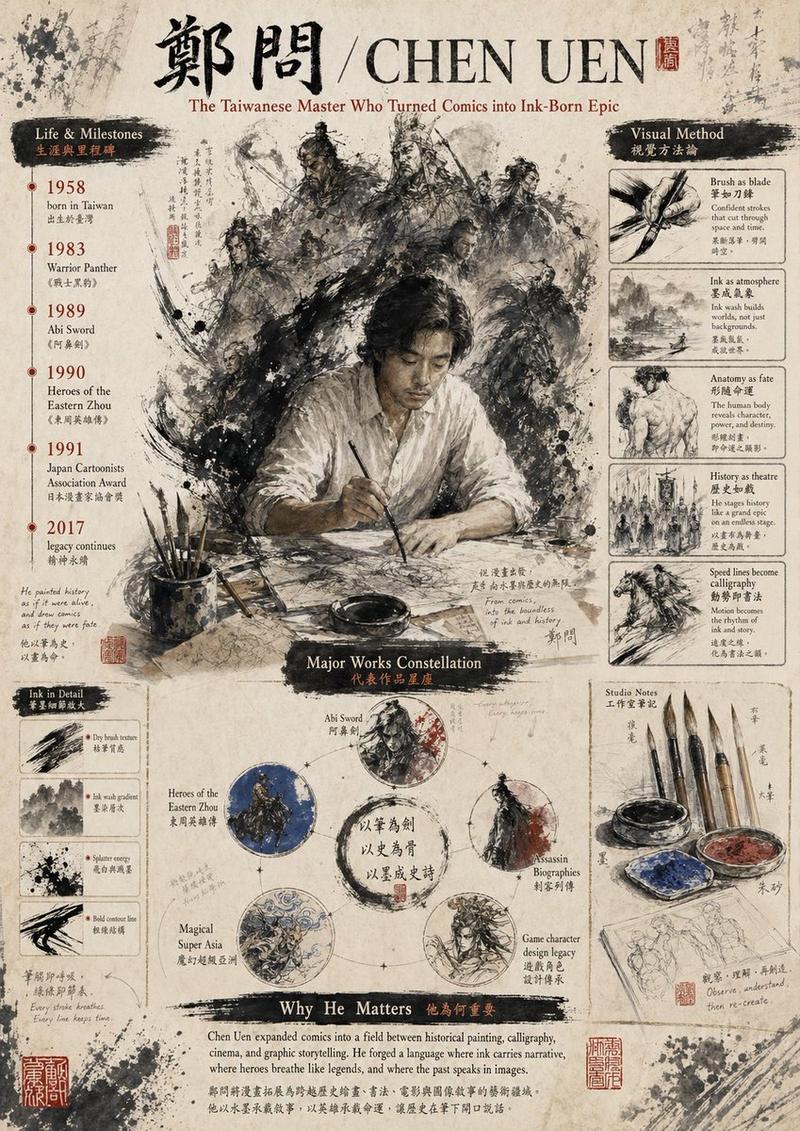
贝多芬神圣书桌拼贴画
提示词
Create a wide cinematic mixed-media historical illustration of {argument name="composer name" default="Ludwig van Beethoven"} composing at a sacred writing desk while silence transforms into musical genius. Use a dramatic 16:9 horizontal canvas with dense collage energy, painterly realism mixed with ink splatter, torn paper, antique manuscript texture, and sweeping abstract motion. Center-left: a curly-haired early-19th-century composer in a black coat and red scarf bends over a dark wooden desk, writing intensely with one white quill on scattered sheet music; his face is obscured by a soft rectangular blur/shadow rather than detailed facial features. On the desk include exactly 3 visible writing objects: 1 white quill, 1 small black ink pot, and 1 taller brass inkwell. Surround him with exactly 3 historical-symbolic zones: left background shows a smoky Napoleonic battlefield with black flags, soldiers, fire, and a distant domed city under dark storm clouds; right background shows a peaceful pastoral river valley with green trees, hills, bright sky, and sunlight; foreground and midground show an explosive avalanche of musical manuscript pages. Include exactly 1 cello standing upright on the far right, warm brown varnish, partly covered by black and gold splatter. Include exactly 1 black bicorne hat in the lower-left foreground with exactly 2 decorations on it: a rosette cockade and a gold medal or insignia; place exactly 1 red cloth draped beside it. Fill the air with many black musical notes, staff lines, torn notation pages, circular cream-and-gold arcs, ink blots, scratches, and gold paint flecks, as if the music is erupting from the desk toward the pastoral landscape. Color palette: charcoal black, aged parchment cream, sepia brown, smoky gray, deep red accents, and metallic gold. Lighting should be high-contrast and theatrical, with the composer and desk dark and brooding, the right landscape luminous, and the whole image feeling like a baroque collage poster about {argument name="theme" default="deafness, war, and the creation of the Fifth and Sixth Symphonies"}. No readable modern text, no watermark, no clean digital UI, no extra people in the foreground.- 分类
- UI 与界面
- 模型
- GPT Image 2
- 来源 ID
- 24528
- 发布时间
- 2026年6月6日
浏览量63