移动端 AI 对话截图与 Transformer 海报
Prompt
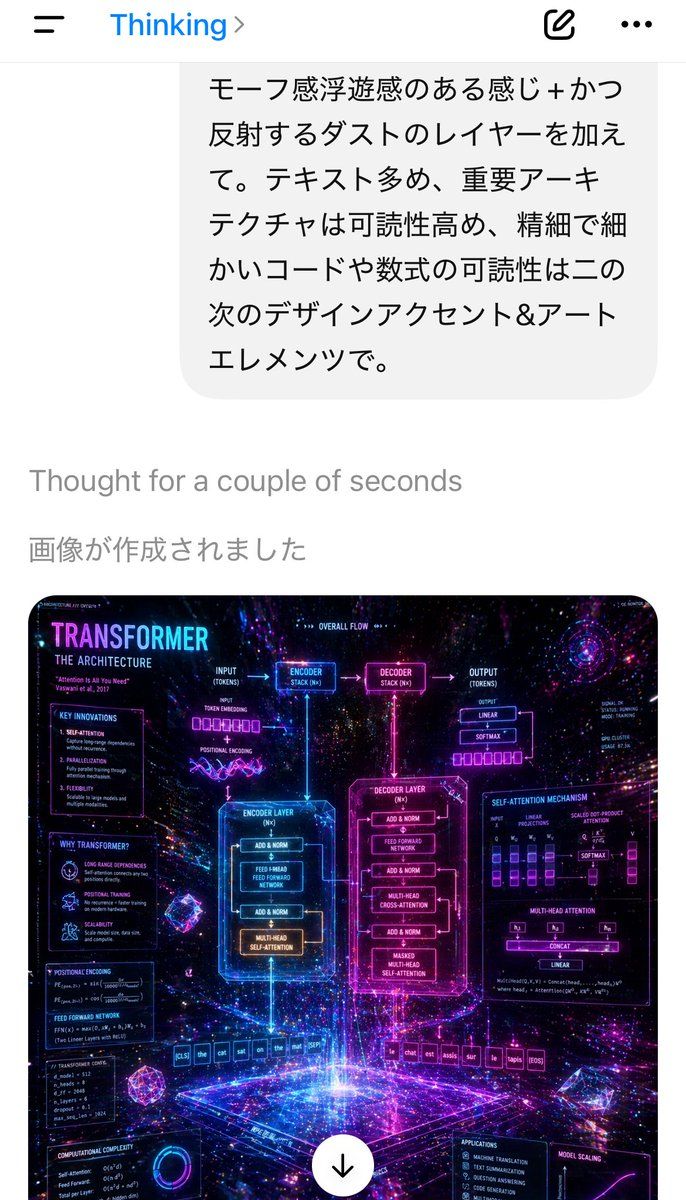
A smartphone app screenshot in portrait orientation showing an AI chat interface in Japanese, with a clean white background and iOS-style top bar. At the very top, display a left hamburger menu icon, blue text reading “Thinking” with a right chevron, an edit compose icon, and a three-dot menu. Below it, show a large rounded light-gray chat bubble containing 6 lines of Japanese text, exactly: 「モーフ感浮遊感のある感じ+かつ反射するダストのレイヤーを加えて。テキスト多め、重要ーアーキテクチャは可読性高め、精細で細かいコードや数式の可読性は二の次のデザインアクセント&アートエレメンツで。」 Under the bubble, place small light-gray system text reading “Thought for a couple of seconds”, then a larger gray Japanese line reading “画像が作成されました”. In the lower half, show 1 generated image thumbnail with rounded corners: a dense futuristic infographic poster about the Transformer neural network architecture, rendered as glowing neon sci-fi holographic UI art. The poster should have a cosmic deep-space background with stars, purple, magenta, blue, and cyan light trails, reflective particles, volumetric glow, and floating geometric crystals. Large title at top left of the poster: “TRANSFORMER”, with subtitle “THE ARCHITECTURE”. Include 2 large central glowing boxes labeled “ENCODER LAYER” and “DECODER LAYER”, linked by arrows and smaller blocks for “ENCODER STACK (N×)” and “DECODER STACK (N×)”. Add many surrounding labeled panels and formulas, including sections for “KEY INNOVATIONS”, “WHY TRANSFORMERS?”, “POSITIONAL ENCODING”, “FEED FORWARD NETWORK”, “COMPUTATIONAL COMPLEXITY”, “OVERALL FLOW”, “SELF-ATTENTION MECHANISM”, “MULTI-HEAD ATTENTION”, “APPLICATIONS”, and “MODEL SCALING”. Show token rows at the bottom, including an English input sequence like “[CLS] the cat sat on the mat [SEP]” and an output sequence in French-like tokens ending with “[EOS]”. Add tiny charts, equations, attention diagrams, and wiring lines throughout, but keep the overall impression artistic and luminous rather than strictly readable. At the bottom center of the poster thumbnail, overlay a white circular download button with a black downward arrow. The overall screenshot should feel like a real mobile ChatGPT-style interface displaying an AI-generated image result, crisp and modern.
- Category
- Charts & Infographics
- Model
- GPT Image 2
- Source ID
- 14541
- Published
- Apr 21, 2026
Views3