Clockrunner 蒸汽朋克项目
Prompt
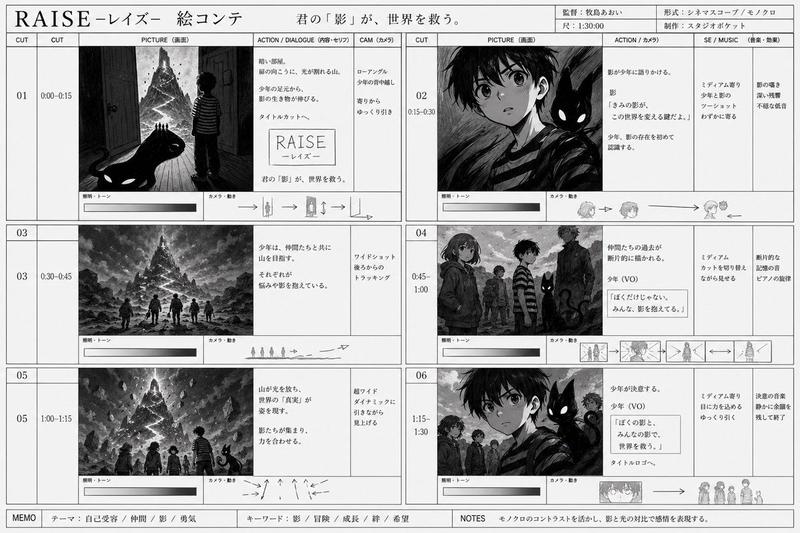
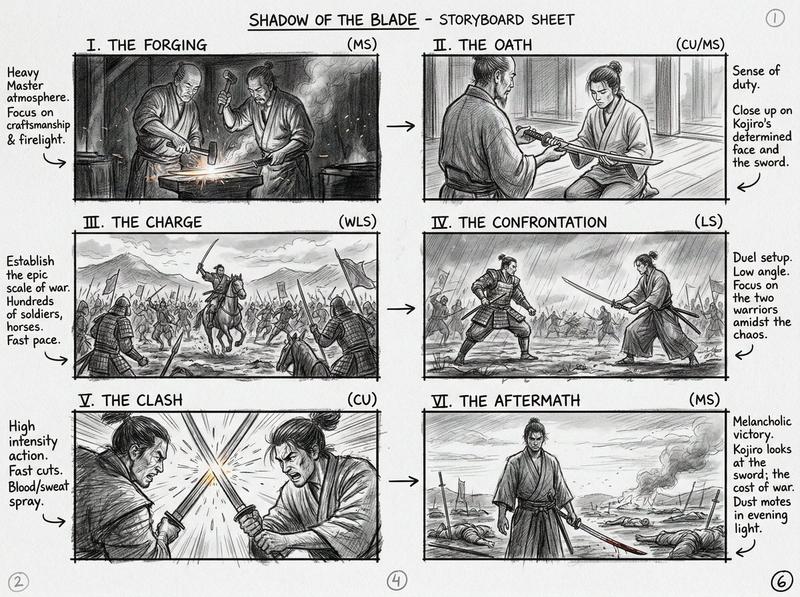
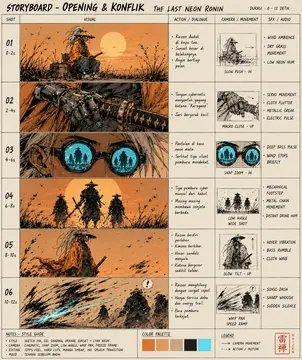
Goal: Create a professional film storyboard sheet for {argument name="project title" default="CLOCKRUNNER"}, a monochrome pencil-and-ink cinematic storyboard set in a steampunk fantasy world of floating clockwork cities above clouds.

Canvas: Wide horizontal storyboard sheet, approximately 16:9, off-white paper texture, thin black panel borders, hand-drawn production-board aesthetic. Add a top header with PROJECT: {argument name="project title" default="CLOCKRUNNER"} on the left, SCENE: {argument name="scene number" default="01"} near the top center, and DURATION: {argument name="duration" default="~15 SEC (24 FPS)"} on the right.

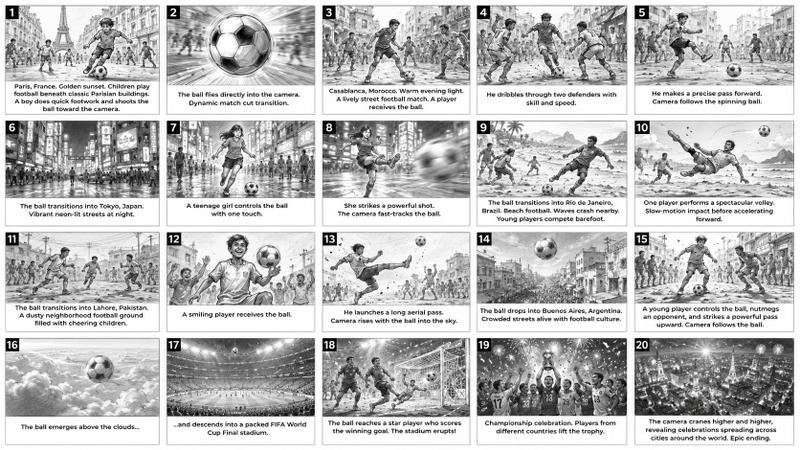
Layout: Use exactly 15 numbered storyboard panels arranged in a clean grid: three rows of five panels. Each panel has a small boxed number in the upper-left corner and a caption block underneath with shot type plus action description. Beneath the 15 panels, add a bottom production strip containing: one character portrait box on the left, a character design notes text box beside it, a visual style notes text box, several full-body/action pose sketches of the heroine across the bottom center, and two detailed chronometer/clock device sketches on the bottom right.

Storyboard panels, exactly 15:
1. Wide establishing shot: a colossal floating city of gears and clock towers drifts above an endless sea of clouds; a narrow metal rail stretches between two suspended platforms.
2. Tracking shot: a young time-smuggler sprints along the rail, mechanical debris raining from above as warning sirens echo.
3. Medium shot: she leaps over broken sections of track; a giant clock mechanism collapses behind her.
4. Close-up: determined eyes and a glowing pocket chronometer spinning in her hand; no panic, only focus.
5. Wide shot: ahead, the rail ends abruptly; a massive gap separates her from the next platform.
6. Medium wide: she accelerates toward the edge; steam erupts from vents beneath the track.
7. Action shot: she launches into the air, coat billowing behind her as she reaches forward.
8. Wide shot: she falls through open sky, far below, clouds swirl around ancient machinery.
9. Close action: a retractable energy tether fires from her wrist; the cable streams toward a rotating clock tower.
10. Medium shot: the tether locks onto a moving gear; the sudden pull swings her across the void.
11. Close shot: she races along the tether; blue sparks trail behind her boots.
12. Wide tracking shot: the camera follows as she glides between giant rotating clock faces, narrowly missing gears spinning all around her.
13. Medium close: she lands briefly on a spinning gear; without stopping, she launches again.
14. Dynamic angle: she bursts through a ring-shaped time portal; fragments of glowing clockwork spiral around her.
15. Wide final shot: she emerges above a luminous city hidden inside the clouds; the horizon glows with golden light as she races toward her destination.

Character: The heroine is {argument name="character name" default="The Clockrunner"}, a female mid-20s athletic agile time-smuggler with short silver hair and asymmetrical bangs, long weathered coat with mechanical details, utility belt filled with time-tech gadgets, glowing pocket chronometer as signature item, steampunk sci-fi aesthetic, fast, fearless, highly resourceful.

Bottom strip details: Include exactly 1 character portrait box, exactly 2 text note boxes, exactly 5 small full-body/action pose studies of the heroine, and exactly 2 chronometer/clock device drawings. The character portrait may have a soft blurred or shaded face area but must still show hair, coat collar, shoulder armor, straps, and clockwork accessories.

Visual style: Cinematic storyboard illustration, ultra-detailed ink sketch, dynamic action composition, steampunk fantasy world, floating cities and giant clockwork structures, high motion energy, monochrome pencil rendering, concept-art quality, 16:9 storyboard panels, film-production storyboard layout, consistent character design across all shots. Use dense hatching, graphite shading, weathered paper, tiny technical details, dramatic perspective, clouds, gears, rails, towers, chains, smoke, and sparks.

Constraints: Keep everything black, gray, and sepia-toned like a scanned pencil production sheet. Make the text legible and in English. Do not add extra panels beyond the 15 listed. No color painting, no photorealism, no modern city elements, no watermark.- Category
- Brand & Logos
- Model
- GPT Image 2
- Creator
- Kiki
- Source ID
- 24845
- Published
- Jun 8, 2026
Views0